Friday, 28 November 2014

From Codissago to Belluno

My diary from that summer of 1998 shows that I made several trips to places such as Cortina, Feltre (Feltre appears later in this blog) and also spent time in Belluno library reading and collecting material as part of the research for writing of The Door of Perarolo.  I had by that time based myself in a hotel in  Belluno which allowed me to cycle the Piave in a series of excursions, returning each day to Belluno on the train.  It wasn't until Thursday the 3rd September that I returned to Codissago to cycle along the Piave from Codissago to Belluno.


Zattieri loading a zattera in the nineteenth century
Codissago nowadays has a rafting museum but little else remains, other than the buildings of the village itself, as a record of the rafting industry whose master raftsmen lived here. 

The quay where the rafts were re-cargoed after their arrival from Perarolo has gone, though the quarry behind the quay remains.  The quarry is used nowadays as a test course for learner drivers and looks rather strange - festooned as it is with road signs!  

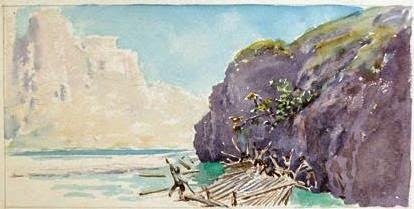
Napoleone Cozzi's charming painting above shows a zattera being loaded with a cargo of wood at Perarolo - and the scene at Codissago would have been similar.  Some of the wood would have been off-loaded as part payment to the zattieri for their work before the loading of much extra cargo - quarried stone, hand tools, etc. - as described in Chapter One of The Door of Perarolo.


With Barbara and Umberto before leaving Codissago
 for the last time in 1998.  [© Peter Alexander Gray 1998]

They don't make shorts like that for cyclists nowadays...


Umberto had advised me to cycle along the left bank of the Piave, as the right bank is dominated by an industrial area and the road is much used by lorries and so forth; the road is also the main route south for motorists heading towards Belluno.


No self-respecting Italian would would be seen cycling in gear like mine - I have 'English tourist' stamped all over me!  My experience on my travels was that Italian lorry drivers enjoyed thundering past close to the bike giving me the wobbles with a good blast of air - together with a good blast on the horn for emphasis!


Timber still plays a major part in the life of the people 
 of the Piave valley. 
[© Peter Alexander Gray 1998]
One of the first things I saw as I cycled south from Codissago was a wood yard full of stacks of timber. As well as being used for the local manufacture of chipboard, timber is a readily-available fuel, and wood stoves are still a major source of domestic heating in Cadore.


The Spiz Gallina silhouetted against the southern light. 
[© Peter Alexander Gray 1998]

Looking down the valley  I could see the characteristic shape of the Spiz Gallina (Hen's Beak).  Shooting into the sunlight created the picture on the left.

The Spiz Gallina is circled in red on the third of the maps below.


Heading down the left bank to Dogna [Carte e Piante Turistiche Tobacco sheet 21]
A bridge takes the road over the Vajont (a little water still flows down the valley).  Then the road rises up towards Dogna.  

Across the valley, where the bulk of the buildings of Longarone were destroyed in the disaster of 1963, a thriving industrial complex is rejuvenating the community.

A section of Longarone sited on higher ground, not directly opposite the Vajont valley, still survives.  The restored part includes the Town Hall, il Municipio.  

The photograph below was taken on the steps of the building in 2008, when my daughter and I visited the region again to take part in the annual walk from Codissago to Perarolo.

I stayed with Michele Berton's family in Castelfranco on the last part of my journey down the Piave valley in 1998.  

Michele was a visiting student (from Padua University) at Aberdeen University during my time as as an academic at Aberdeen.


At Longarone, left to right: Michele, Umberto, Jenny Gray, PAG. [ ©Peter Alexander Gray 2008]


That day in 1998 my bicycle, Una, and I made our way up the hill to the village of Dogna. The houses of the village are very much today just as they would have appeared in the nineteenth century.  
Dogna church [ ©Peter Alexander Gray 1998]


The surfaced road, the lampposts, the cars together with the modern clothes worn by the boy kicking a football are the only strong signs of a century of change.  


Beautiful old houses in Dogna [ ©Peter Alexander Gray 1998]


I recall, looking back on my own youth, playing football by kicking the ball against a wall just like the lad in the photo - probably for the same reason - because there wasn't enough of us to get up much of a team in our small country village.


Church and houses in Provagna [ ©Peter Alexander Gray 1998]

Time was short.  I took the picture to the right of Provagna and a few more before heading on down the valley again.  

You can find some very professional photos taken in both these lovely villages here.  

The road down the valley between Dogna and Provagna was steep in places so I was glad to be able  freewheel downhill to the bridge that crosses the Piave below Provagna, shown on the map below (lower LH corner).


Dogna to Provagna[Carte e Piante Turistiche Tobacco sheet 21] 


My diary tells me that I didn't cross the river but instead continued to follow the road that flanked the left bank of the Piave.


There are many small streams and rivers running down the flanks of Monte Toc (Top RH corner of the map below) and the Spiz Gallena (circled red).  


South of Provagna [Carte e Piante Turistiche Tobacco sheet 24] 


As I headed south the road came close by the Piave - too close.  The river at some time had been in flood and it had washed away a section of the track.  There was a barrier to stop motorists going further, and beyond that the road - according to my diary notes - 'just disappeared into thin air'.   However, other cyclists had been there before me, so I followed their tracks up through woodland and then down back towards the Piave, where the road continued.


A dried-up river or a flow of rocks? [ ©Peter Alexander Gray 1998]

Now and then I would come across what looked like a dried-up river bed full of white dolomite rocks. These may indeed have been river beds (for there had been little rain and the weather was still hot and dry that year, even in early September) or they may have been examples of a boa di ghiaia – which means 'a landslide of stones' in the Cadorino language.  These landslides are common throughout the Dolomites as the mountains (once a huge coral reef) are made of soft rock which cracks under the action of ice formation in the winter months.  


The palestra di roccia in the Gallina valley [Carte e Piante Turistiche Tobacco sheet 24] 


In the Gallina valley there is the palestra di roccia, literally the 'rock climber's gymnasium'.

This is the sort of training ground for would-be alpine mountaineers that can be found in the Cadore region.


Along the left bank to Sovèrzene  [Carte e Piante Turistiche Tobacco sheet 24] 


The dam in the Gallina valley, like the one in the Vajont valley, feeds the HEP (hydro-electric power) station at Sovèrzene (marked Cetrale di Sovèrzene ) on the map above.  The dotted blue lines show the network of tunnels that extend over a vast area of Cadore.


Cycling up the hill out of the Gallina valley was the toughest test for Una and myself that hot day.  It was a steep ascent!  I was glad to coast down the hill through Sovèrzene to the bridge over the Piave, and so cross to the right bank, so as to take the road south to Ponte nelle Alpi.  

When the bridge was built a special ramp was constructed to allow the safe passage of zattere.  You can see it if you look carefully!


Ponte nelle Alpi (Capo di Ponte)  [Carte e Piante Turistiche Tobacco sheet 24] 

Ponte nelle Alpi was originally called Capo di Ponte (the name used in The Door of Perarolo).

Before arriving at Belluno I wanted to take photos inside the little church there, the chiesa di Santa Caterinabut the three old ladies acting as custodians there told me that photography wasn't allowed inside the church.  There are many fine photos of the church to be found on the Internet, such as this one.  


One of old ladies put the lights on inside the church for me.  My notes tell me that there was a very old display 'like an ancient Welsh dresser' stocked with religious artifacts. The altar was lit by electric candles.  I left a donation towards the upkeep and was told that Santa Caterina was the oldest church in Veneto.  I recorded in by diary that it was a very beautiful bijou church.

Leaving Ponte nelle Alpi I had to head back north a short distance and take a left fork onto the main road that runs along the right bank.  Then it was a straight run along the main road to Belluno and a hot shower back at the hotel.


If you have seen the photographs of the zattere in the post Zattere you may have wondered what happened to these amazing rafts after their historic journey downriver to Venice.


One of them was bought by the owner of a restaurant near Belluno and put on display outside under the cover of some trees.


One last surviving zattera [ ©Peter Alexander Gray 1998]
Littered with leaves and with one oar post missing it was still a great thrill, that evening, to walk the length of this amazing river craft.  But if you're standing outside one of the best restaurants in the Belluno district, the obvious thing to do is to go inside and try the menu...


They're happy because... [ ©Peter Alexander Gray 1998]
Are they happy because they eat lard?  No, I think it was the red wine...  Except in Barbara's case - she is only a moderate consumer of wine.  Umberto and myself though, the owner of the restaurant (wearing his kitchen apron) and the random Italian who decided to join us have all had too much of the vino rosso.


OK, here's a test for Italian language students.  Can you explain this T shirt in Italian?  [ ©Peter Alexander Gray 1998]

In next month's post Una and I head south towards one of the best preserved of all Italian towns - Feltre.


Note: This blog supports readers of The Door of Perarolo, a historical novel set in Cadore, Italy in the early nineteenth century.  You can examine feedback from readers in the UK here and in the US here.  The Door of Perarolo is a Kindle ebook comprising 140 chapters.  It can be downloaded from Amazon sites worldwide.  The launch post of this blog gives further details.  The second post provides links to maps, etc.


Sunday, 19 October 2014

Vajont, Erto and Longarone


The old river port of Codissago lies on the left bank of the River (Fiume in Italian) Piave.   
Una (my bicycle) and I arrived for the first time in Codissago  late on the evening of 29th August 1998.  I was visiting my old friend Umberto Olivier.  

Barbara checks out Umberto's pose.   [© Peter Alexander Gray 1998]

Please note that I have already posted in this blog here information concerning Codissago.  
The photograph on the right was taken outside Umberto's house in Via IX Ottobre, Codissago.   I stayed there that night and the next morning Umberto took us both on a tour round the villages surrounding the Vajont dam.

Umberto is a native of Longarone, and was in Milan on a business trip when the terrible events of the Vajont Dam Disaster of October 1963 occurred. As a result, he was the only member of his family to survive.


The events leading up to the disaster and the aftermath are the subject of Renzo Martinelli's film 'Vajont'.  The film features the attempts of the communist journalist Tina Merlin to alert the government to the effects of the construction of the Valont reservoir next to Monte Toc which, up to the night of the 9th October, had exhibited signs of an imminent landslide. This was in the form of movement cracks on the north face bordering the lake, and cracks forming in the walls of building in the villages around the lake.

At 10.39 pm more than the usual number of people were in the three inns of Longarone watching the football match between Real Madrid and Glasgow Rangers, when the disaster happened.

260 million cubic metres of rock (marked 'FRANA DEL MONTE TOC' on the map below) slipped off the north face of Monte Toc into the reservoir causing huge waves, big enough, for example, to take the roof off the schoolhouse at Casso.  Most of the small villages around the lake were reduced to rubble.  

If you examine the map below carefully you will see a shape like a crescent moon, but black in colour.  This is the barrier of the original reservoir.  The lake (Lago del Vajont) itself has been shifted about two kilometres east as a result of the vast landslide.  

To extract water from the lake, engineers have bored a tunnel (dotted blue lines) through the debris of the landslip; today the Vajont reservoir provides water for HEP (hydro electric power) and also water for the irrigation of crops.


Map showing the location of Castello Lavazzo, Codissago and Longarone [Carte e Piante Turistiche Tobacco sheet 21]


Below the reservoir, to the west, Longarone was wrecked and buried under mud.  Codissago was also severely damaged.  Over 2000 people died.  Tina Merlin's book Sulla Pelle Viva tells the whole story on which the film is based.


Lago del Vajont and Erto, San Martino and Pineda [Carte e Piante Turistiche Tobacco sheet 21]

Umberto drove us both around the Vajont valley in his car.  After 35 years, life had returned to some sort of normality, though pain and resentment were still there to see. 


Erto in 1998  [© Peter Alexander Gray 1998]
SADE (Società Adriatica di Elettricità) - the Italian energy monopoly - built the dam  despite warnings that the entire side of Monte Toc was unstable and would likely collapse into the reservoir if the filling were completed.


Construction was completed in 1963 and in March of that year the dam was transferred to the newly constituted government service for electricity, ENEL. During the following summer, with the reservoir almost completely filled, tremors and cracks in the ground were continuously reported by worried local people.  All the authorities, including the government, ignored the reports.  The sign on the wall in the photo above says SADE + ENEL + Government = 2500 dead.


Today, much of the site of the old town of Longarone has been redeveloped as industrial units bringing greatly-needed employment in the form of light manufacturing.   The timber industry is still much in evidence, too.  There is a new church in the town which is also a memorial to the people in the area who died in 1963.

I'm sorry that the subject of this month's post is such a sad one.  In the next post will continue the journey south along the riverside towards Belluno.

Note: This blog supports readers of The Door of Perarolo, a historical novel set in Cadore, Italy in the early nineteenth century.  You can examine feedback from readers in the UK here and in the US here.  The Door of Perarolo is a Kindle ebook comprising 140 chapters.  It can be downloaded from Amazon sites worldwide.  The launch post of this blog gives further details.  The second post provides links to maps, etc.

Sunday, 21 September 2014

From Rivalgo to Codissago


The last post has brought much correspondence.  
Initials over the gate in Rivalgo [Courtesy Franco Baldissarutti]

I must thank in particular Giancarlo Soravia in Venas di Cadore, Vittorina in Il Covo dei Zater in Perarolo, Franco Baldissarutti in San Stefano, and Enzo Zanvettor from Ospitale who was visiting Perarolo recently and spoke with Giancarlo on the subject of the initials over the gate at Rivalgo

In the last blog taken from my audio diary of August 1998 I stated that the initials over the gate (the wrought iron gate on the opposite side of the street from the church) were 'CJM'.  I was wrong.


In fact they are 'CSM' and stand for Cristoforo Svaluto Moreolo.  The name 'Svaluto Moreolo' is one of an ancient family of the Cadore region.  I had no idea that a chance observation would throw up so much discussion!  A big 'thank you' to Carlo et al!


Rivalgo looking north [Courtesy Aldo De Bastiani]
In the 19th century the Svaluto Moreolo family owned sawmills in the Piave valley, and had property in Venice.  Cristoforo's initials CSM appear on a well there bearing the date 1887.

I am recently indebted to Aldo De Bastiani for giving me permission me to use his fine photograph of Rivalgo, showing the church and the gate on the right.  

Since the last post blog post Franco Baldissarutti has contacted me again to say that the gateway has now been demolished (the house that stood in the grounds beyond was demolished many years ago).  I would assume that this was to allow the road to be widened,which in turn would be of benefit to the facade of the church which is subject to wear and tear from debris thrown up by through traffic.


My audio diary from that Saturday in August 1998 tells me that it was approaching  5.00 pm and the light was fading fast - the Piave flows through a valley flanked by mountain ranges  on both banks.  

Una (my bicycle) and I had a quick look at Ospitale before pressing on downriver (see the previous post for details of the great rock in the river, Sas Levado, upstream of Ospitale).


The Piave valley between Rivalgo and Ospitale [Tabacco Carte e Piante  Turistiche Sheet 21]


The tiny church at Ospitale
[© Peter Alexander Gray 1998]
My diary records that '...there is a little stream (the Valbona) running down through Ospitale 'in terraces'.  Beautiful hills everywhere...'  I took one hurried photo of a tiny church, then pressed on down the Piave.

The photo (attribution unknown) below shows a better view.  This is part of Ospitale is Sottospitale (Lower Ospitale). 


There exists another larger church further up the hill, but, that evening, time was short  and I needed still to visit Termine before heading finally to Codissago to stay the night with my friends there, Umberto and Barbara.


On old maps the name of the town is shown as 'Hospitale' (the letter 'h' - rarely used - is not aspirated in spoken Italian).   Umberto Olivier told me (the next day) that Ospitale gives its name to the word 'hospital'. The name of the village itself originates from an ancient hospice (the building still survives in Upper Ospitale) intended for pilgrims and wayfarers passing through.


The Piave valley between Ospitale and Codissago
[Tabacco Carte e Piante  Turistiche Sheet 21]

It was time for Una and I to set off downriver again.  What a day!  From Cima Sapadda to Calazo... then Pieve, Perarolo, Ospitale...  I was exhausted!

I permitted myself a quick visit to Davestra, but there wasn't time to photograph any of a most interesting village, before Una and I were away again heading south to Termine.

Termine is so-named because it is situated at the southern  limit of the region where the Cadorino language is spoken in Cadore.  Immediately south of Termine, the language that was spoken in the 19C was Bellunese.  With the coming of television in particular, the Italian language has become dominant throughout Italy.

But local languages are still important, and there are many institutions dedicated to the recording and preserving of these languages.  Anyone speaking Italian and interested in knowing more about the Cadorino language should visit Carlo Soravia's quite exceptionally detailed blog.  There you will find also links to much fascinating information about the history and culture of Cadore.

For those of you who have been following the Scottish referendum this year, let me say Scotland, as a nation, has confirmed it is happy to remain part of the United Kingdom.  We have, as in Italy, many local languages.  I prefer to call them languages, as they are not dialects of English.  The language still spoken in the region of Scotland where I live (the Moray coast) is Doric.  It is not related to Gaelic,  other than it imports 'loan words' - as do all languages.

I digress!  Let me say I am once again indebted to Franco Baldissarutti for writing to me and sending me a photo - in this case of Termine.
The church at Termine looking down the street
 [Courtesy Franco Baldissarutti]
Here is Franco's photo of the wonderful little church there. My diary of 1998 states, 'It is the smallest church - the building is square but the corners are cut off!'

At 6pm the light was really bad - but this was the most remarkable little place of worship I had seen so far on my journey down the Piave valley, so I had to try and take a photo.


The church of S. Maria Maddalena
looking up the street  in the half light
[© Peter Alexander Gray 1998]


Above is my own attempt on a darkening Saturday evening in August 1998.  Then it was down the Piave again - not the easiest stretch passing by the cliffs under Castello Lavazzo with heavy traffic roaring past - over the Ponte Malcolm and so into Codisaggo.  I have already published a lengthy post about Codissago in this blog.  You can read it here.  The next post covers the stretch of river from Codissago to Belluno, and also says a little about that saddest of subjects - Vajont.

Note: This blog supports readers of The Door of Perarolo, a historical novel set in Cadore, Italy in the early nineteenth century.  You can examine feedback from readers in the UK here and in the US here.  The Door of Perarolo is a Kindle ebook comprising 140 chapters.  It can be downloaded from Amazon sites worldwide.  The launch post of this blog gives further details.  The second post provides links to maps, etc.

Tuesday, 26 August 2014

Downriver from Perarolo towards Codissago

It was time to leave Perarolo behind and head down the Piave valley on my bike.  The water level in the Piave will no longer support rafting, due to the complex system of dams that have been built which draw off water for crop irrigation and for HEP (hydro-electric power).  


A rainy Perarolo looking south [© Peter Alexander Gray 2012]

However, we can find from records what it was like to travel on a commercial raft leaving Perarolo for Codissago.  

The travel writer Napoleone Cozzi described such a journey made in August 1898, and his description has never been bettered:

Of the first moments, there remains only a confused memory: the sharp command of the head zattiere, the strike of oar that with resolve directs us in the middle of the river, the chorus of the salutes and the wishes that rise from the bank; at the first bend Perarolo disappears.

Napoleone Cozzi's 19C sketch of a three-section zattera
What a feeling! What a profusion of ever-new wonders, how many unexpected beauties, what lights, what coolness!

The zattera normally follows the principal trunk of the river; now it winds in narrow or wide curves, silent and fast; it passes out under a rock of lead, it pushes through the foliage, it goes into a gorge, then exits free into a wide river basin.

At the bottom, at the opening of the valley that catches the eye, the last violet crags seem to compete among themselves to be first to show their details; they are made grey, they offer the cleanest contour, the most definite shades; they cast on the margins of still water their trembling reflections, they pass quickly, showing patches of blossom, scrubs of firs, unexpected rivulets, landslides, paths, valley dwellers, ravines, torn banks, vagueness in all the forms; they disappear at a turning to reappear later behind us, distant, with their forms made smaller, confused, with the forests pale, with their lines lost among the light shades.

We pass rustic cottages, isolated or in groups, pass flour mills, bridges, sawmills; valleys supply secondary tributaries that add to the increasing greatness of the Piave, with cascades, with a last fall or by just gently flowing down through their flat beds of gravel. 

Up there aloft, on the road that follows the line of the river... holidaymakers look us bewildered, answering our mimed greetings with the waving of handkerchiefs.

Heading downriver         [© Peter Alexander Gray 1998]
The road which I cycled in 1998 followed the same river, but was a much wider, modern road.  The flow of the Piave being much reduced nowadays can make the river (lower left-hand corner) more difficult to photograph from the road.

I hadn't time to stop and look at the famous Madonna della Salute chapel at Macchietto, as I had set off from Cima Sappada the morning of that same day (August 1998), and visited Pieve and Perarolo en route.  


The Piave valley between Macchietto and Ospitale
Carte e Piante Turistiche Tobacco sheet 1

The travel writer the Reverend Robertson, travelling north through the valley in the late nineteenth century, wrote:

The next two villages, Rivalgo and Riccorbo [sic], have a place in both ancient and modern history. Both are mentioned in documents of the thirteenth and fourteenth centuries in connection with the wood trade, and both are famous in the struggle to throw off Austrian rule in 1848. Just outside the former place is another obelisk of red stone.  


Obelisk from 1848.  The names of the Cadorini were added 150 years later
It was difficult to realise, as we drove along amid scenes of peacefulness and beauty, the terrible fighting that took place here so recently. As we approached Riccorbo [sic] there was just room for the road to pass under the cliffs that overhung the Piave. Here the leader Calvi barricaded road and river, and had the cliffs undermined as at Tovanella, and men stationed with levers to hurl the shattered rocks upon the enemy, When the Austrians with disastrous results. In the pause that ensued a flag of truce was displayed by the enemy, and Calvi caused hostilities to cease, and prepared to speak with the Austrian General Sturmer, when the cry of treachery arose. Under cover of the flag the Austrians were scaling the cliffs above. The Cadorini fought with redoubled energy, and the Austrians, 5000 strong, were forced to retire. General Stiirmer praised the heroism of the Cadorini, and was more than astonished afterwards to learn that they were not regular soldiers, but only undisciplined mountaineers.


In my diary of 1998 I wrote: 

It’s half past four and I am at Rivalgo.  Looking around, the whole place has been blasted by [debris thrown up by] passing road traffic.  What a great shame – it was was clearly once a quaint old town. 
The church at Rivalgo - image © Franco Baldissarutti

The church at Rivalgo.Image © Franco Baldissarutti
There is a very small church; on the left of it is a square tower with the bell in arches.  Tiled roof.  Entrance to church archway with square windows on either side arches and metal grill with circles set into it - all metal.  Frescos on the front which is a creamy colour.

I am most grateful to Franco Baldissatrutti for permission to use these images.


There is one more entry in my diary relating to Rivalgo.  

Huge iron gate to my right [on the opposite side of the road] with CJM on the top – wonder if it is someone descended from the Malcolm family of Longarone?  

Gate at Rivalgo with initials 'CJM'
Image © Franco Baldissarutti
I've flipped Franco's original image (taken on the other side of the gate from where I was standing in 1998) so as to make the initials 'CJM' more easily recognised).


The diary continues:

Looking down the valley there are sand quarries.  I’m only about a third a way down [the valley towards Codissago] so need to press on towards Ospitale.

There is a huge rock in the river north of Ospitale - the Sas Levado.  
The Sas Levado [© Peter Alexander Gray 1998]

Here the zattere were pushed into a narrow channel, where rocks and submerged branches could damage the craft.  Once past the Sas Levado the rafts plunged down into safer waters - if they were still in one piece!


Franco Losso in his informative article Da Codissago a Perarolo says 'Along the first stage [from Perarolo to Codissago], with so many risky points, the Sas Levado was, for the zattieri, perhaps the one of the most imminent danger...  


All Napoleone Cozzi's beautiful watercolour illustrations (the full-size portfolios) are held in the collections at the Centro Regionale di Catalogazione e Restauro dei Beni Culturali.

There were numerous cataracts and falls along the river.  Napoleone Cozzi's trip was a good one:


But these impatiences, this restlessness, these nervousness, are compensated at some points by exuberance, the most beautiful, the most grand of the journey, that don't have comparison, that raise above every
superlative, over every well-worn cliché: The falls!

They are five of it or six of them.  What a strange impression the first time!  That double near Longerone is sublime!


By now at a certain distance, the
course of the river seems truncated by a dam that crosses it leaving a narrow outlet over which the enormous liquid mass falls with a roar. Looking within into one’s thoughts the whole desire is to believe that the zattera will surely be held back or diverted by whoever known means one can devise, from who knows what providential source.  Run free instead and dare the Devil! It is an unworthiness; it must be a big a colossal jest or a madness without name; the zattèri must be crazy. There is by now no escape; in a few moments we will be absorbed, swallowed. Speed still increases, the roar becomes more and more deafening. You want to cover your face with your hands, would want to rebel and make a desperate jump for  the fleeing gravel banks.

We are there: The two front men leave the oars, they turn them and fix them with ropes; the first part of the zattera squeals, it folds up, it falls, to disappear. Behind us upright, fierce, impassive as the god of the storms, the head zattiere directs a last stroke of the oar, then lowers it and now also secures it.  Here is the instant: Gods of the abyss! The support goes from under us; fingers grab on to the beams, become entangled with the ropes, with the cords, and with a big cry of passion we sink, intoxicated with emotion, licked up by a wave of foam, wound by a downpour of silver spray.

The stretch between Perarolo and Longarone lasts a couple of hours and is the most beautiful in life.  It is a mix of enchanting feelings that are happening fast and continuous. It is a dream radiated by delicious images. It is a jubilation, of which a single recollection is sufficient to cure all the melancholies of man’s life and it is a wonder that it is not the preferred amusement of half of humanity.


Note: This blog supports readers of The Door of Perarolo, a historical novel set in Cadore, Italy in the early nineteenth century.  You may examine feedback from readers in the UK here and in the US here.  The Door of Perarolo is a Kindle ebook comprising 140 chapters.  It can be downloaded from Amazon sites worldwide.  The launch post of this blog gives further details.  The second post provides links to maps, etc.

Sunday, 20 July 2014

July Postbag

A recurring question from readers concerns names - the names of characters in The Door of Perarolo and also place names.

Annie in Hereford has asked me specifically about the
name 'Fortin'.  Fortin in French means 'little fort'.  Not that I would have known that if it wasn't for Nadia, a dear friend who lives in Paris.   My thanks go out to her and Veronique, both of whom helped me with so many things French while writing The Door of Perarolo, especially the proverbs and quotations.


A little fort
My thanks to Le Wooden Toy
 for permission to use this image

Xavier Fortin was one of those people historians never record.  He wasn't famous, he was just an ordinary person.  Someone for sure arranged the transportation of the masts  from the Dolomites to Venice, but it wasn't someone like Tupinier or Maillot.  People in positions of authority don't do donkey-work.  

So I gave this anonymous person a name: Xavier Fortin.  I needed to give him a surname that could be either a French name or an Italian one.  Knowing he was a strong man, I chose Fortin.  

There are many Italians whose last names that have that 'in' ending.  Pierre Cardin is one.  He was born in 1922 in a town near Venice, moving to France after WW2.


Johann Karl Freiherr von Hiller
When writing The Door of Perarolo I worked from my research notes keeping as close as possible to the known facts about Tupinier, Maillot, Salvini, Hiller, Bellegarde, Murat and all the rest of the real historical characters.  

For those Austrian characters that were fictitious I generally used real Austrian names: Reithoffer, Stumpf, Fingerlos, Prieler, Seidler, Erstweiler... and so on.  

For fictitious French and Italian surnames I often used names that had an amusing translation - did you translate them, I wonder?  

I also added one new separable verb to the German language (new additions to the language are encouraged in Germany) and one new collective noun to the English language.  Did you spot these, too?  If so - well done!

The exceptions I made to the rule of using real names as regards Italian surnames relate to those surnames belonging to families living in Codissago; the surnames of the zattieri di Codissago survive to this day, and I didn't wish to cause any offence to the good people of that town.  So I limited myself to the use of first names.
The church of Santi Pietro e Paolo in Tarvisio


As regards place names, over the years the names of many towns have changed.  In the time frame covered in the narrative of The Door of Perarolo Tarvis  was a town  in Austria.  Nowadays it is renamed Tarvisio and is part of Italy. 

Illyria, a province of the French Empire until 1814, in modern times is part of Slovenia and Croatia. Many towns have been renamed.  Karlstadt, for example, is now called Karlovac.  

Many Italian towns that have remained in Italy have had their names changed or modified during the last two centuries.  Some have been foreshortened.


Map showing the route over the Simplon
Duomo d'Ossola ('Cathedral of Ossola' - Ossola being a region of NW Italy) nowadays is called Domodossola.   

This is my map marked (blue arrows) with the route I took when hitch-hiking through Switzerland and over the Simplon in July 2000.

Below is an extract from my diary.  I was following the route taken by the Campbell family (recorded in Beaujolois Campbell's diary) in 1817 -  first mentioned in the New Year postbag.


DOMODOSSOLA

For once Beaujolois doesn't say where they stayed in the town.  I booked into a hotel close to the station (, where I met  the owners, Sergio and Luigia BartoLucci,  and their daughter.  I explained why I had come to their town and they expressed great interest.  

We chatted in Italian most of that evening.  Their hotel, the hall virtually a museum, reflects their strong interest in the history of the region.   They showed me an original document signed in 1809 in Milan by Napoleon’s step-son Eugenio, commemorating the completion of the Simplon road.
Original [Simplon] document from 1809,  in the Hotel Eurossola, Domodossola  (P.A.G 2000)

I explained  that  I was looking for a hotel that would have existed in 1817, in the centre of the town within the old walls.

They told me of two old inns, one of these, now the Pizzeria Terminus, they felt  sure would have been the one.  I was hungry, so that evening I went there to eat a fine pizza.  As I ate I had plenty of time to survey the impressive 14th century vaulted ceilings, very similar in style to those I saw in the lobby of the Lion d'Or (where the Campbells stayed briefly before travelling to Brig to stay the night, before mounting the Simplon)  at Sion in Switzerland.


Beaujolois, in her diary: 'We slept at Duomo d'Ossola where I heard everyone talking Italian... The beds were large but dirty.  The people looked like rogues...' This is my photo from July 2000. To the left, under the striped awning, is the Pizzeria Terminus.    


The church of Santi Quirico e Giulitta, Castellavazzo (P.A.G. 2008)

Here's another example of the way names can change in Italy.  

The citizens of Castello Lavazzo held a referendum in 2011 as to whether to adopt Castellavazzo as their name, which they did!

The town is on the opposite bank of the Piave from  Codissago.  


That's enough about names!  Next month's blog will resume our voyage down the Piave.

PS: Thanks to you all for your comments and queries.  In grateful also to all those who have posted reviews on Amazon sites since the last postbag, the most recent being Mike in Hereford (thanks, Mike!).

Note: This blog supports readers of The Door of Perarolo, a historical novel set in Cadore, Italy in the early nineteenth century.  You may examine feedback from readers in the UK here and in the US here.  The Door of Perarolo is a Kindle ebook comprising 140 chapters.  It can be downloaded from Amazon sites worldwide.  The launch post of this blog gives further details.  The second post provides links to maps, etc.